
No quality team wants a client complaint to be the first clear sign of an interpretation problem. By that point, the call is over, the client experience has been affected, and everyone is trying to reconstruct what happened.
The challenge is not a lack of care. It is scale. A busy LSP may handle far more calls than its reviewers can listen to from beginning to end. Small samples are necessary, but they can hide patterns.
AlfaOne gives the QA team an AI-assisted starting point for reviewing recorded calls against an approved scorecard. Qualified reviewers remain responsible for the final score and for any feedback, coaching, or corrective action.
Why interpretation QA becomes reactive
Most LSP quality teams are working with limited time, several client programs, and standards that vary by language, domain, and service type. Four problems tend to follow.
Review coverage stays narrow. Listening to every call is rarely practical. When the sample is small, a recurring issue may look like an isolated incident.
Scoring varies between reviewers. Even experienced reviewers can interpret criteria differently, especially when scorecards are unclear or programs have different requirements.
The warning arrives late. Complaints and escalations provide useful information, but only after the service has already been delivered.
Coaching becomes too general. Advice such as “be more accurate” or “follow protocol” is difficult for an interpreter to apply without a specific criterion and a clear example.
The aim of proactive QA is not to remove human review. It is to help reviewers cover a more representative set of calls and reach the important evidence sooner.
Keep the call and the scorecard together
A practical workflow begins with the context of the call: the language pair, the interpreter, and the approved scorecard for that client or program. The recording is then provided through the agreed secure process.
AlfaOne brings relevant call information and the scoring breakdown into one report. Depending on the available data and review setup, that view may include the call duration, participants, speaker and transcription status, audio quality, complexity, overall QA score, and signals that deserve a closer look.
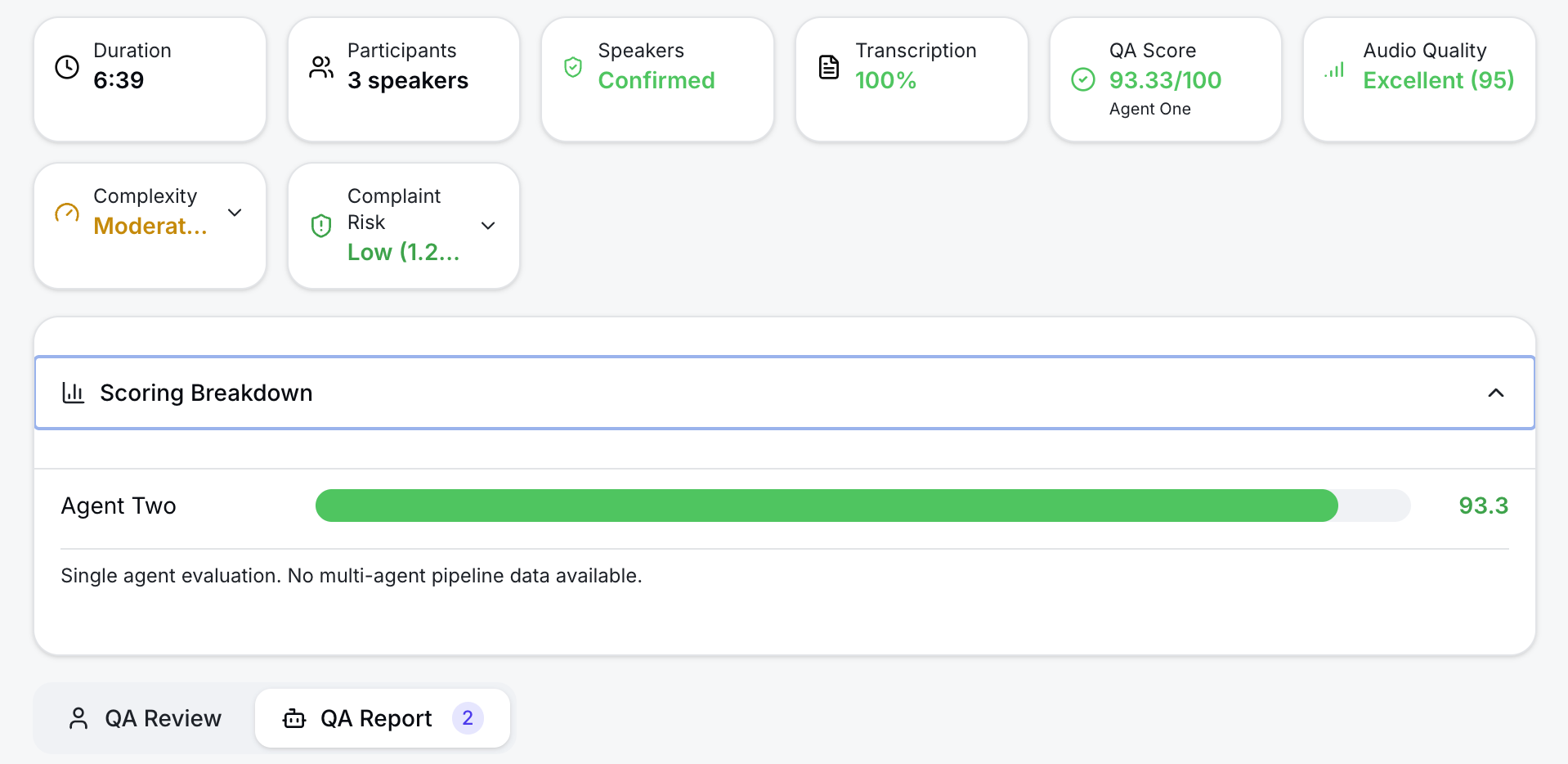
The report is not the final decision. It helps the qualified reviewer move to the relevant evidence, confirm or adjust the score, and decide whether the call requires feedback, coaching, follow-up, or no action at all.
Let the scorecard define quality
Interpretation quality cannot be reduced to one universal number. A medical encounter, a legal appointment, and a customer-service call may require different protocols and different levels of risk control.
The approved scorecard should therefore remain at the center of the process. It may cover accuracy, protocol adherence, professionalism, and requirements specific to the client program. Clear ownership and version control matter too, so the team can see exactly which standard was applied to each call.
AI assistance is most useful when it works within those agreed criteria. It should help apply the standard consistently, not quietly create a new one.
Make the findings useful to everyone involved
For the LSP, earlier visibility can help the QA team focus its time, see recurring risks, and prepare stronger evidence for client conversations.
For the client, the process shows that agreed standards are being applied and concerns are being followed up.
For the interpreter, feedback can become more specific. Instead of receiving a broad warning, the interpreter can see which criterion needs attention and what good performance looks like.
This shared understanding is valuable. Quality management works better when the standard, the evidence, and the reason for a decision are clear to the people responsible for the service.
Prove the approach with a focused pilot
An LSP does not need to change its whole QA program at once. Start with one language pair, one approved scorecard, a representative set of recorded calls, and a small group of qualified reviewers.
Before the review begins, agree on a few practical measures:
- Coverage: Can the team review a more representative set of calls?
- Turnaround: Do useful findings reach the right people sooner?
- Score agreement: Do the AI-assisted suggestions and reviewer scores generally align?
- Coaching value: Do recurring findings lead to clearer, more focused action?
Review disagreements as carefully as agreements. They can show where the scorecard needs clarification, where reviewers need alignment, or where the assisted review needs adjustment.
Before expanding, confirm the controls required by the organization and its clients. These may include access permissions, secure and time-limited transfer, approved scorecards, duplicate protection, verified result delivery, scorecard versioning, and program-specific data-retention rules.
See the issue while there is still time to act
Proactive interpretation QA gives the quality team a better chance to find meaningful patterns before a client has to point them out. AlfaOne brings the call context, AI-assisted analysis, and scorecard-based review into a clearer workflow. People remain accountable for the judgment. The system helps them reach the evidence sooner.
If your team wants to explore a more proactive approach, begin with one language pair and the scorecard you already trust. Review the evidence together before deciding whether to expand.
See AlfaOne in action or speak with the AlfaOne team about a focused interpretation-QA pilot.